


Football Slide Board Training: Build the Lateral Explosiveness Your Game Demands
Football is not a straight-line sport. Every route, cut, shuffle, lateral pursuit, pass-protection set, and open-field tackle requires multi-directional explosiveness and hip stability that most conventional gym programs simply don't train. Squats, deadlifts, and bench press build raw strength — but they operate almost exclusively in the sagittal plane. Football happens in all three planes simultaneously.
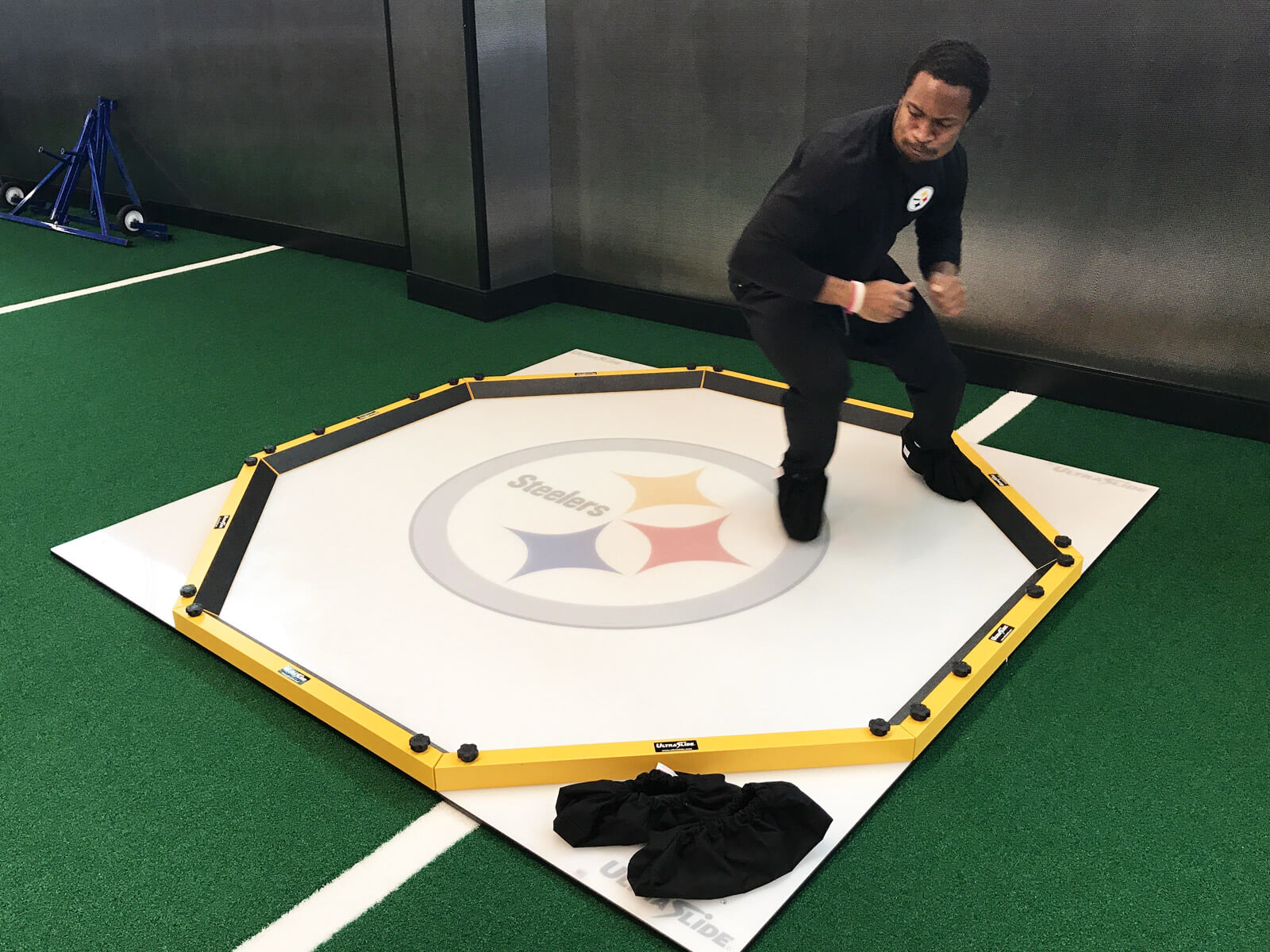
The UltraSlide® slide board changes that equation. Used by NFL teams, Division I programs, and elite skill coaches, the slide board is the one tool that forces your hips, ankles, and core to work the way they do on the field — laterally, explosively, and under load.
Why Most Football Programs Leave Lateral Athleticism Undertrained
Traditional football strength programs are built around the "big lifts" — and for good reason. Strength is foundational to performance at every position. But raw sagittal strength doesn't automatically transfer to the lateral movements that define football athleticism.
Consider what actually happens during a play:
- A wide receiver breaks out of a route with a lateral jab-step, cutting at full speed
- A cornerback mirrors a route with repeated shuffle-steps, hips loaded at 45° angles
- A linebacker pursues a sweep laterally across the field for five or six yards
- An offensive lineman fires out in a lateral zone-block, generating force off a side angle
- A running back absorbs a block and cuts back against the grain
These movements demand hip abductor strength, ankle stability, lateral power output, and core anti-rotation stiffness — attributes that back squats and leg presses develop poorly at best.
The UltraSlide fills that gap. Its low-friction surface demands full lateral loading and hip drive on every stroke, training the exact movement patterns that separate good football athletes from elite ones.
Position-by-Position:
How the Slide Board Translates to the Field
The UltraSlide delivers targeted benefits across all positions. Here's how each position group directly applies slide board training:
| Position Group | Slide Board Benefit | On-Field Transfer |
|---|---|---|
| Wide Receivers / DBs | Lateral cut mechanics, hip loading, first-step explosiveness | Route breaks, press coverage, open-field tackles |
| Running Backs | Change-of-direction agility, hip stability, deceleration control | Cut-back runs, receiving out of backfield, option reads |
| Offensive / Def. Linemen | Lateral footwork, pass-set mechanics, hip mobility under load | Zone-block execution, pass protection, lateral pursuit |
| Linebackers | Lateral shuffle speed, hip drive, pursuit angles | Zone drops, scrape exchanges, sideline-to-sideline range |
| Special Teams | Explosive lateral coverage, balance, conditioning | Gunner lanes, return blocking, kick coverage gaps |
| Quarterbacks | Hip mobility, pocket movement, lower-body stability | Pocket presence, play-action fakes, rollout mechanics |
The Four Athletic Qualities the Slide Board Develops in Football Players
1. Hip Abductor & Adductor Strength
Football cuts, shuffles, and lateral pursuits are powered by the glute medius, hip abductors, and inner thigh adductors — muscles that standard barbell training rarely isolates with meaningful load. The slide board's lateral resistance pattern targets these muscles directly, building the lateral hip power that drives every cut route and coverage step.
2. Core Anti-Rotation & Anti-Flexion Stability
The best football players hold a braced, stable core through contact, pursuit, and change of direction. Slide board training is fundamentally an anti-rotation exercise — resisting rotational collapse as you drive through each lateral stroke. This directly translates to blocking strength, tackling form, and ball-carrier contact absorption.
3. Multi-Directional Metabolic Conditioning
Football is a game of explosive sprints separated by brief recovery windows. Slide board interval training — 10-to-30-second bursts at maximal lateral speed — mirrors that metabolic demand precisely. Unlike treadmill or track conditioning, which is sagittal and linear, slide board work builds the anaerobic capacity to repeat lateral explosions throughout a game.
4. Ankle Stability and Injury Resilience
Ankle sprains and knee injuries are among the most common football injuries — and many originate from poor lateral deceleration mechanics. Regular slide board training conditions the ankle stabilizers and knee-tracking muscles to handle the lateral load they'll face in competition, reducing injury risk while improving change-of-direction speed.
UltraSlide® Football Training:
Performance Impact at a
Glance
| Training Quality | Standard Gym Training | UltraSlide® Slide Board |
|---|---|---|
| Lateral Hip Power | Minimal — mostly sagittal plane | Primary — every stroke loads the lateral hip |
| Core Anti-Rotation | Indirect — mostly stabilizer work | Direct — resisting rotation is the whole movement |
| Change-of-Direction Mechanics | Rarely isolated | Built in — each push-off mirrors a field cut |
| Football-Specific Conditioning | Linear, non-sport-specific | Lateral bursts mirror game-speed intervals |
| Ankle Stability | Partially addressed | Loaded on every stroke; stabilizers adapting constantly |
| Equipment Footprint | Large — requires floor space, machines | Compact — 6-10 ft, portable, boards lay flat for easy storage |
Trusted by the NFL and Elite Football Programs
The UltraSlide is trusted not just by individual athletes, but by NFL organizations, Division I college programs, and high school strength coaches who need tools that deliver measurable results under real competitive pressure.
"UltraSlide is a big part of the Green Bay Packers' Strength and Conditioning program and has been so for a long time. The original boards as well as the smaller boards are versatile and far-reaching in their application. We use them for interval work as well as a wide variety of strength and mobility exercises on a regular basis."
— Mark Lovat,
Former Strength & Conditioning Coordinator, Green Bay Packers
"After playing in the NFL for 7 years, I became a Sports Performance Coach & made it a point to train my clients on the UltraSlide for maximum results. Hamstring strength, core strength, balance, and training in the frontal plane are all necessary when bulletproofing your body as an athlete. UltraSlide covers all of that and more."
— Mikhael Ricks,
7-Year NFL Veteran & Former Sports Performance Coach
5 Football-Specific UltraSlide® Exercises
These exercises are drawn from sport-performance training programs and are specifically designed to target the physical qualities that matter most in football.
Exercise 1: Lateral Shuffle Intervals (All Positions)
The foundational slide board drill. Push off one bumper, fully extend through the hip and knee, then load the opposite hip as you arrive at the far bumper. Perform 10–20 second work intervals at maximal effort, 60 seconds rest.
- Target muscles: glute medius, hip abductors, quads, calves
- Football transfer: coverage shuffles, pursuit angles, lateral zone blocking
- Sets/reps: 6–8 intervals at 15 seconds work / 45 seconds rest
Exercise 2: Single-Leg Lateral Push (Skill Positions)
Place one foot on the slide board surface and push laterally off a single leg, holding a brief pause in the extended position before recovering. Develops unilateral hip power and ankle stability critical for cut routes and coverage breaks.
- Target muscles: glute medius, hip flexors, peroneal ankle stabilizers
- Football transfer: route breaks, press-bail technique, open-field cuts
- Sets/reps: 3 × 8 each leg, slow and controlled
Exercise 3: Lateral Lunge with Slide (Linemen & Linebackers)
Stand beside the board and slide one foot laterally into a deep lunge position, holding the bottom for 1–2 seconds before returning. Develops hip mobility and lateral stability under load — directly replicating the hip-width set positions used in pass protection and scrape exchanges.
- Target muscles: adductors, glute max, hip flexors, core
- Football transfer: pass-protection sets, block shedding, lateral pursuit
- Sets/reps: 3 × 10 each side
Exercise 4: Plank Slide-Outs (All Positions — Core Stability)
From a strong plank position, place hands on the slide board surface and slide arms forward and back, or laterally, while maintaining a rigid torso. This is a direct anti-extension and anti-rotation core exercise under constant feedback.
- Target muscles: transverse abdominis, obliques, lats, shoulder stabilizers
- Football transfer: blocking contact absorption, tackling form, ball security under contact
- Sets/reps: 3 × 10 controlled slides, 3-second return
Exercise 5: Defensive Back Reaction Drills (DBs / Linebackers)
Partner-driven or coach-cued: athlete stands centered on the slide board and reacts to verbal or visual cues to explode laterally to either bumper. The slide board's low-friction surface eliminates false-start grip advantage and forces pure hip-driven first-step mechanics.
- Target muscles: hip abductors, glutes, reactive neuromuscular system
- Football transfer: man coverage, zone awareness, first-step quickness in blitz packages
- Sets/reps: 5 × 6 cued reps, focusing on clean first-step mechanics
Choose the Right UltraSlide® for Your Football Program
UltraSlide offers four board lengths to match any program — from an NFL team room to a high school weight room or individual athlete's home gym.


All UltraSlide® boards include:
✓ Durable low-friction surface engineered for athletic slide performance ✓ Foam bumper blocks at each end for safe, controlled push-offs ✓ Slide booties included — fit over any athletic footwear ✓ Portable and easy to store — boards lay flat for easy storage ✓ Made in the USA | 30+ years trusted by elite programs
Football Slide Board Training
Frequently Asked Questions
Is a slide board actually useful for football, or is it more of a hockey/skating tool?
Slide boards are genuinely versatile and have been adopted by football programs at the NFL, college, and high school levels. The Green Bay Packers have incorporated the UltraSlide into their official strength and conditioning program for years. The core athletic qualities a slide board develops — lateral hip power, frontal-plane conditioning, ankle stability, and core anti-rotation strength — are every bit as relevant to football as they are to hockey. Any sport that demands lateral explosiveness and multi-directional movement benefits from slide board training.
Which positions benefit most from slide board training?
Every position benefits, but skill positions (WR, DB, RB) and linemen (OL/DL) tend to see the most direct transfer. Wide receivers and defensive backs develop sharper cut mechanics and lateral hip loading. Linemen improve lateral footwork in pass protection and zone-blocking sets. Linebackers improve lateral pursuit speed and hip-drop mechanics. That said, quarterback hip mobility and special teams athleticism are also well-served.
How long are sessions on the slide board?
Football-focused slide board sessions typically run 10–20 minutes as a complement to strength training or as a standalone conditioning tool. Interval-based work (10–30 second efforts at maximal intensity with equal or greater rest) most closely matches the metabolic demands of football. Longer, steadier sessions are also effective for aerobic base building in the off season.
What size board is right for a team setting vs. individual training?
For team programs with multiple athletes rotating through stations, the 8 FT or 10 FT boards are ideal — more lateral distance means more training stimulus per rep and the ability to accommodate taller athletes. For individual training or home gym setups, the 6 FT board provides a full workout in a compact footprint. The BB Max 5.5 FT is an excellent entry-level option for personal athletes and youth players.
Can offensive and defensive linemen use a slide board effectively given their size?
Absolutely. Many of the most effective slide board exercises for linemen don't require full end-to-end sliding. Lateral lunge holds, split-stance lateral presses, and plank core work are all highly effective for larger athletes. The UltraSlide's board surface and bumpers handle athletes across all size ranges. The 8 FT and 10 FT boards provide additional width that larger athletes appreciate.
How does the slide board integrate with existing football strength programs?
The slide board works best as a complement to — not a replacement for — traditional strength training. Most programs integrate it in one of three ways: (1) as a dynamic warm-up and activation tool before lifting sessions, firing the hip abductors and lateral stabilizers before heavy compound work; (2) as a conditioning station on circuit or metabolic conditioning days; or (3) as a dedicated movement skill session during in-season maintenance training when full-intensity strength sessions are limited.
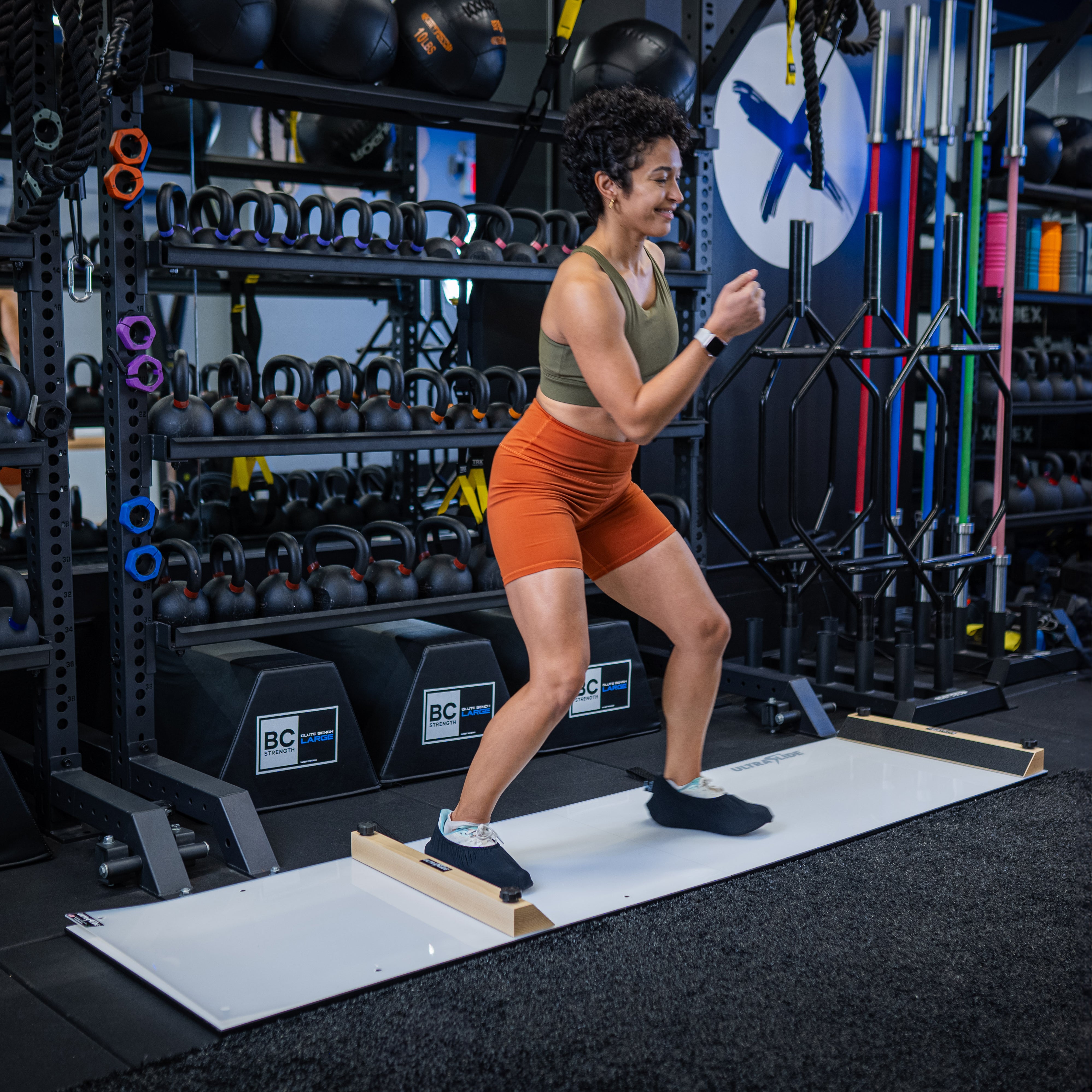
The gap in most football training programs isn't strength — it's lateral athleticism. The UltraSlide® slide board is the most direct way to build the hip power, frontal-plane conditioning, and change-of-direction mechanics your players need to perform at the highest level.
Trusted by NFL teams, college programs, and elite skill coaches for over 30 years, UltraSlide is purpose-built for athletes who train seriously.
For team pricing or bulk program inquiries, Contact us at info@ultraslide.com or call toll-free 800-259-5356